
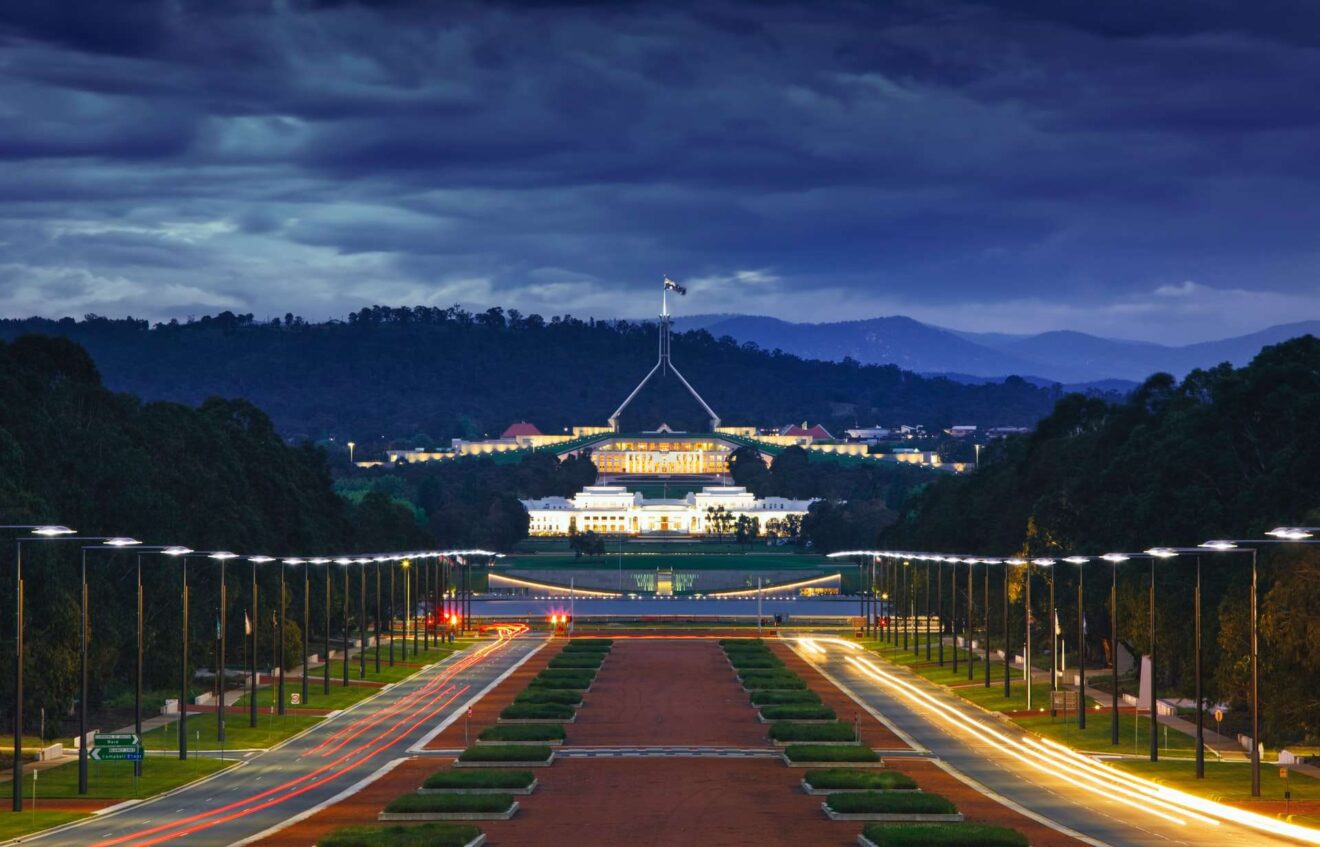
Before, during and after the Federation of Australia on 1 January 1901, there was public bickering amongst parliament members about what and where the federal territory and seat of government should be. It was written in the Constitution that the site must be at least one hundred miles (160km) away from Sydney, NSW. During this lengthy process of finding an appropriate location, Parliament would sit in Melbourne until the appropriate home was found and the new parliament house was built.
One of the members of the first federal parliament, King O’Malley (yes he was an actual person before the pub) believed that ‘cold climates have produced the greatest geniuses’. After this comment, over 60 country towns in New South Wales were promoted as possible sites for the capital due to their climate, purity of water supplies or their large volume of supply of stone and timber for construction. Towns along the main railway were heavily considered due to their accessibility between both Melbourne and Sydney. Though sites like Albury were considered too close to Melbourne and Armidale and Tamworth were considered too far from Sydney and way too far from Melbourne.
In 1902, members of both Houses of Parliament went out to inspect the nominated sites. The politicians felt a strong attraction to sites on the south-east of the state of New South Wales despite the freezing cold climate. After this, Parliament held its first vote on the location. The Senate proposed Bombala whereas the House of Representatives chose Tumut. Six months later, the town of Dalgety (small township just north of Bombala) was chosen instead. However, the New South Wales government refused to accept and support Dalgety as the capital and pushed for a site closer to Sydney. It was here that towns such as Orange and Bathurst were pushed strongly from the New South Wales Government. As a compromise, a ‘new’ site at Yass-Canberra was found and was considered an acceptable location. Being almost exactly a hundred miles (160km) from Sydney, this large district boasted of clean air, good water supply and a strong, cool climate. In October 1908, a bill called the Seat of Government Bill was passed by Parliament which confirmed that Yass-Canberra would be the capital of Australia. This meant that New South Wales would provide land off the coast so that a seaport could be provided to the federal city. This seaport would be Jervis Bay.
An international competition was opened for the design of the bush capital which applicants were told would be the ‘official and social centre of Australia’. The main person driving this competition was the one and only Charles Scrivener himself who was a surveyor. Chicago architect Walter Burley Griffin was the winning entrant for the competition and it was said that Griffin’s design would create ‘the only really modern city in the world’.
When the region of Canberra consisted of no more than an outback sheep station and was divided by the Molonglo River in 1913, a ceremony took place to name the city ‘Canberra’, the new name of the capital. The name was a sentimental favourite and logical choice as it was derived from the local Aboriginal word for ‘meeting place’ and was already in use in the district for more than three-quarters of a century. However, prior to this, the people of Australia responded to the Governments invitation for naming the city and some came up with the following: ‘Cookaburra’, Wheatwoolgold, Sydmelperadbrisho’ and Meladneyperbane’. The politics around the whole naming debacle created other names such as ‘Swindleville’, ‘Gonebroke’ and ‘Caucus City’.
It was the end of bickering and debacle when on 12 March 1913, Lady Denman, who was the wife of the Governor-General, stood on a crimson-draped platform and declared in a clear English voice, ‘I name the capital of Australia, Canberra – the accent is on the Can’.
Interested in learning more about Canberra? Find out what time zone is Canberra in our article.